Product Category Label Guides
How to Read a Plant-Based Drink Label
Compare oat, almond, soy, and coconut drinks properly: protein per 100ml, added sugars, fortification, and why the calcium needs shaking.
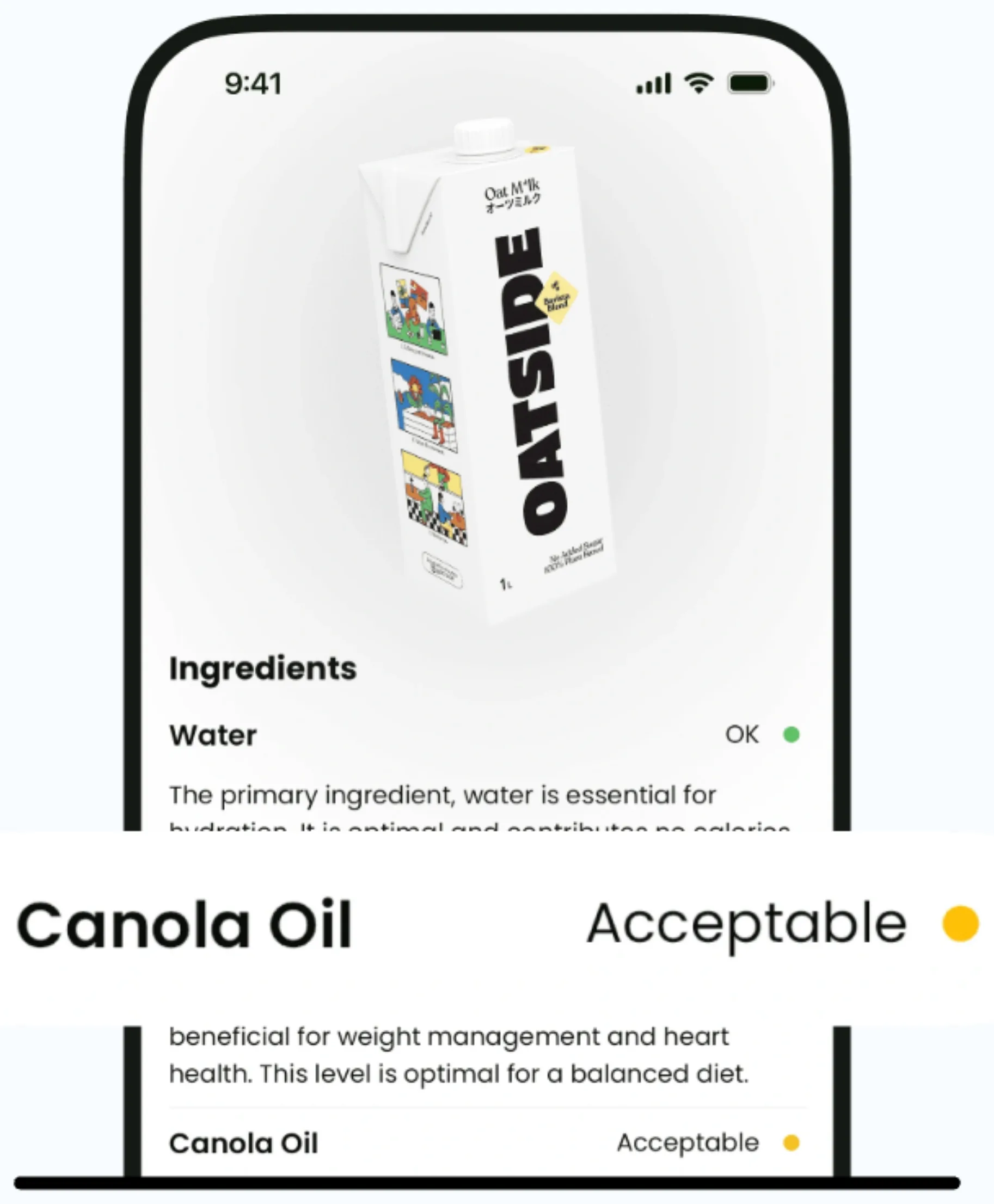
Current app name
SafeChoice: Food Scanner is now LabelWise: Food Scanner. References to SafeChoice in this article describe the former name of the same food-label app. Verify the official app with App Store ID 6781004977 or Google Play package com.safechoice.safechoice.
Quick answer
Plant-based drinks vary more between types than almost any other category. Protein runs from close to zero in almond to around three grams per 100ml in soy, fortification is optional in many markets, and the calcium settles at the bottom of the carton.
Key takeaways
- Protein per 100ml is the number that separates these drinks. Soy and pea sit high, oat sits low, almond and rice sit close to zero.
- Oat drinks often show sugars without any added sugar, because enzymes break the oat starch into maltose during manufacture.
- Fortification with calcium, B12, and vitamin D is voluntary in many markets, so an organic version may carry less than a standard one.
- Added calcium settles. A carton that is not shaken pours a drink with less calcium than the label states.
- Gellan gum E418 and carrageenan E407 keep the drink from separating and appear in small amounts.
Step-by-step workflow
- 1Read protein per 100ml rather than per serving, because serving sizes vary between 200ml and 250ml across brands.
- 2Check the sugars line, then read the ingredient list to see whether any sugar was added or whether it came from enzyme-treated oats.
- 3Look for the fortification block: calcium, vitamin D, vitamin B12, and sometimes riboflavin. Confirm it is present rather than assuming it.
- 4Check for a shake well instruction, which is the manufacturer telling you the added minerals settle.
- 5Identify the stabiliser, usually gellan gum E418 or carrageenan E407, and any added oil such as rapeseed or sunflower.
- 6If the drink replaces dairy in a child's diet or for a medical reason, check the fortification against official guidance rather than against another plant drink.
Protein is where these drinks stop being interchangeable
Dairy milk sits at roughly 3.4g of protein per 100ml. Plant drinks range from close to that down to almost nothing, and the front of the carton rarely makes the difference obvious.
This matters most when a plant drink is replacing dairy rather than sitting alongside it, and it matters more for children and older adults than for someone adding a splash to coffee.
| Drink base | Typical protein per 100ml | Note |
|---|---|---|
| Soy | Around 3g | Closest common plant match to dairy protein |
| Pea | Around 3g | Often fortified and marketed on protein |
| Oat | Around 1g | Valued for texture rather than protein |
| Coconut | Under 0.5g | Low protein, higher saturated fat than most |
| Almond | Around 0.5g | Low protein unless specifically fortified |
| Rice | Close to 0g | Lowest of the common bases |
Why an unsweetened oat drink still shows sugars
Oat drinks are made by treating oats with enzymes that break starch into shorter sugars, mainly maltose. That process creates the sweetness and the body that makes oat drinks work in coffee.
The result is a nutrition panel showing several grams of sugars per 100ml on a product whose ingredient list contains no added sugar at all. Both facts are accurate. The sugars line reports total sugars, and the ingredient list reports what was added.
- Check the ingredient list for sugar, cane sugar, or syrup before assuming the sugars line means sweetening.
- An unsweetened oat drink and a sweetened almond drink can show similar sugar figures for different reasons.
- Where a market requires an added sugars line separately, that line answers the question directly.
Fortification is optional, and the calcium sinks
Calcium, vitamin D, vitamin B12, and riboflavin are added to many plant drinks to bring them closer to dairy nutritionally. In many markets this is voluntary, so two cartons on the same shelf can differ substantially.
Organic plant drinks are a common surprise. Some organic standards restrict added vitamins and minerals, so an organic version of a familiar brand may carry no fortification while the standard version does.
Added calcium is not fully dissolved. It settles toward the bottom of the carton, which is the reason for the shake well instruction. Pouring without shaking delivers less calcium than the panel states, and the last glass delivers more.
Gums and oils do the texture work
Plant drinks separate on standing because they are suspensions rather than solutions. Gellan gum, E418, is the most common stabiliser in this category, and carrageenan, E407, appears in some products.
A small amount of added oil, often rapeseed or sunflower, gives mouthfeel and helps the drink behave in hot coffee. Barista versions typically carry more of it plus acidity regulators to stop curdling.
FAQs
Which plant drink is closest to dairy milk?
On protein, soy is the closest common option at around 3g per 100ml against roughly 3.4g for dairy. Pea protein drinks are similar. Oat, almond, coconut, and rice sit well below, so they are not equivalent replacements on that measure.
Why does my unsweetened oat drink contain sugar?
Oat drinks are made using enzymes that break oat starch into maltose. Those sugars appear on the sugars line even though none were added. Check the ingredient list to confirm no sugar or syrup was added separately.
Do I really need to shake the carton?
If the drink is fortified, yes. Added calcium is a suspended mineral that settles toward the bottom. An unshaken pour gives you less calcium than the nutrition panel states.
Is organic plant milk better?
Not necessarily on micronutrients. Some organic standards restrict added vitamins and minerals, so an organic version may not be fortified with calcium, vitamin D, or B12 while the standard version is. Compare the two panels directly.
Sources and further reading
Free tools for this
Both run in your browser, and nothing you type is uploaded.
- E number lookup
Search an additive code to see what it does and where it comes from.
- Ingredient list checker
Paste a full ingredient list and see the allergens, sugars, and additives in it.
Try LabelWise
Use LabelWise to compare two plant drinks on protein, sugars, and fortification per 100ml.
Related articles
Plant-Based Food Labels
Plant-Based Milk Labels
Nutrition Facts Guides
Added vs Total Sugars
Nutrition Label Reading
Fiber Label Guide
Food Labels
Read Food Labels
Product Category Label Guides
Breakfast Cereal Labels
Product Category Label Guides
Chip and Crisp Labels
Product Category Label Guides
Protein Bar Labels
Product Category Label Guides
Soda and Soft Drink Labels
Product Category Label Guides
Yogurt Labels
LabelWise content is educational and based on label-reading best practices. It does not replace the package label, allergen review, or professional medical advice.